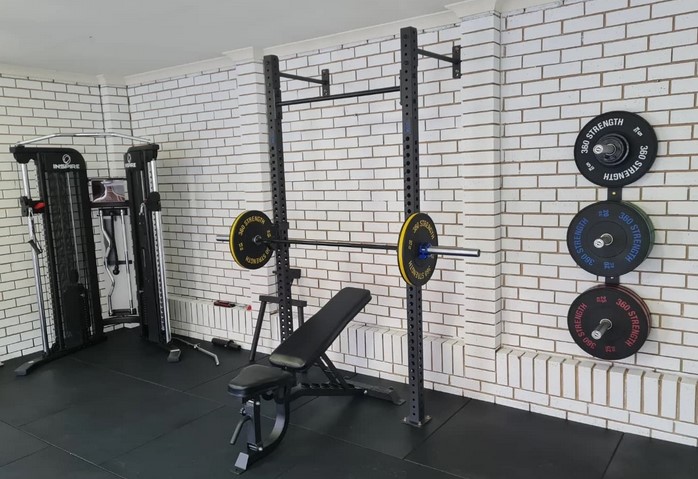
It’s 6:00 PM on a rainy Monday. You’ve just finished a grueling work shift, and the thought of driving fifteen minutes to a crowded commercial gym—only to wait in line for a sweat-slicked bench—feels like a second job. You look at that dusty corner in your spare room or the empty space in your garage and think, “Could I actually get fit here?” The answer is a resounding yes. In fact, studies show that people with home setups are 33% more likely to stick to their fitness goals over a year compared to those with gym memberships alone.
In my twelve years as a health writer and fitness consultant, I’ve seen the “home gym” evolve from a single pair of rusty dumbbells into a high-performance sanctuary. I’ve personally made the mistake of buying “as-seen-on-TV” contraptions that ended up as expensive clothes hangers. What I’ve learned is that a successful home workout isn’t about having a room full of chrome machines; it’s about choosing high-utility home gym essentials that offer the most “bang for your buck” per square inch.
Building a home gym is like building a Swiss Army Knife. You don’t need a giant toolbox; you need a few high-quality tools that can do a hundred different things.
The Foundation: Why Less is Often More
The biggest trap beginners fall into is the “Complete Set” mentality. You don’t need a rack of twenty different dumbbells to see results. I’ve coached clients who transformed their physiques using nothing more than a few key items and a bit of floor space.
When you curate your home gym essentials, you are looking for Versatility, Durability, and Footprint. If a piece of equipment only does one movement (like a leg extension machine), it’s a waste of space. If it can help you squat, press, row, and lung, it’s a winner.
Analogy Time: Think of your home gym like a capsule wardrobe. Instead of fifty cheap shirts, you buy one high-quality blazer, a great pair of jeans, and a solid pair of boots. You can mix and match those few items to create dozens of outfits. Your equipment should work exactly the same way.
The “Big Three” Home Gym Essentials for Strength
If you want to build muscle and bone density—the pillars of longevity—you need resistance. Based on my decade of experience, these are the three non-negotiables.
1. Adjustable Dumbbells
Space is the ultimate currency in a home gym. A full rack of dumbbells can take up an entire wall. Adjustable versions allow you to change weights (from 5 lbs to 50 lbs or more) with the turn of a dial. This allows for progressive overload—the technical process of gradually increasing the stress on your body to force it to get stronger.
2. Resistance Bands (The “Hidden” Heavy Lifter)
Don’t be fooled by their lightweight appearance. Heavy-duty looped resistance bands provide Variable Linear Resistance. This means the further you stretch the band, the harder it gets. This mimics the natural “strength curve” of your muscles, making them incredibly effective for both strength training and mobility work. Plus, they fit in a drawer.
3. A Multi-Purpose Adjustable Bench
Training on the floor limits your range of motion. A sturdy, adjustable bench allows you to perform incline presses, seated rows, and step-ups. Look for one with a high weight capacity and “grippy” upholstery; you don’t want to be sliding around when you’re trying to push a personal best.
Cardio and Conditioning Without the Treadmill
Many people think home gym essentials must include a $2,000 treadmill. I’m here to tell you that unless you are a competitive marathon runner, you can skip the bulky cardio machines.
-
The Jump Rope: For under $20, a jump rope provides some of the highest metabolic conditioning possible. Ten minutes of jumping rope can burn as many calories as an eight-minute mile run, while improving your coordination and bone density in the feet and ankles.
-
Kettlebells: The kettlebell is a hybrid tool. It provides a brutal cardio workout through “swings” and “snatches,” while doubling as a weight for squats and presses. If I could only have one piece of equipment for the rest of my life, it would be a 16kg or 24kg kettlebell.
Scannable Checklist: Curating Your Space
If you are just starting out, use this list to prioritize your purchases:
-
High-Density Flooring: Protect your joints and your floor tiles with interlocking rubber mats.
-
Pull-Up Bar: Even if you can’t do a full pull-up yet, “dead hangs” are excellent for spinal decompression and grip strength.
-
Suspension Trainer (TRX): Uses your body weight as resistance and can be anchored to any door. Excellent for “core stability” and functional movement.
-
Foam Roller: Your “in-home” massage therapist. Essential for myofascial release and reducing post-workout soreness.
Expert Advice: Insights from the Trenches
After a decade of reviewing gear and testing setups, I’ve discovered a few “hidden truths” that will save you money and frustration.
Tips Pro: The “Mirror” Psychology
Never underestimate the power of a large wall mirror. It’s not about vanity; it’s about Biofeedback. In a home gym, you don’t have a coach to correct your form. Watching your reflection during a deadlift or a squat helps you spot “rounding” in your back or “caving” in your knees. It is the cheapest safety insurance you can buy.
The Mental Shift: Consistency Over Equipment
The most important “equipment” in your home gym isn’t something you can buy at a sporting goods store—it’s your routine.
The danger of a home gym is that it’s always there, which makes it easy to say, “I’ll just do it later.” I’ve found that the most successful home athletes have a “Trigger.” Put on your workout shoes, turn on a specific playlist, and step into your designated “fitness zone.” Treat your home workout with the same respect you would a paid appointment with a trainer.
Conclusion: Build Your Sanctuary Today
Choosing the right home gym essentials is an investment in your future self. By focusing on versatile tools like adjustable dumbbells, resistance bands, and a solid bench, you remove the barriers of time, travel, and “gym-timidation.”
You don’t need a palace; you just need a corner and the commitment to show up. Start small—perhaps with just a kettlebell and a mat—and build your sanctuary as your strength grows. The best time to start was yesterday; the second best time is right now.
Are you planning to convert a garage, a bedroom, or just a corner of your living room? What’s the one piece of equipment you absolutely can’t live without? Share your home gym dreams in the comments below—I’d love to help you optimize your layout!