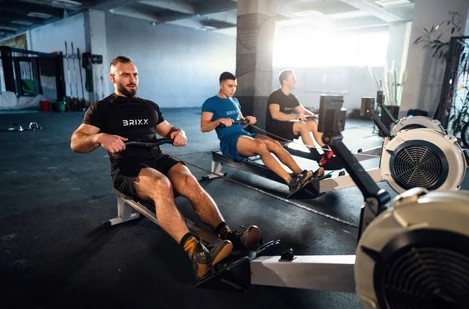
You step into the gym, past the usual wall of humming treadmills, and notice the rower tucked into the corner—pulling double-duty as a coat rack for someone’s gym bag. Over my ten years writing about fitness and working alongside strength coaches, I have watched this exact scenario play out thousands of times. People flock to the treadmill to log their miles, completely unaware that the most effective engine for cardiovascular endurance and total-body conditioning is sitting right there, completely ignored.
If your standard cardio routine feels monotonous, or if your knees are protesting the endless pavement pounding, it is time to pivot. Rowing for cardio isn’t just an alternative to running; it is an upgrade.
Why Rowing for Cardio Outperforms Standard Gym Machines
Most classic cardio machines isolate your lower body while your upper body sits idle. Rowing flips this dynamic entirely.
The True 86% Muscle Engagement
A common misconception is that rowing is primarily an upper-body exercise. In reality, a proper rowing stroke uses 86% of your body’s muscle mass across nine major muscle groups.
Think of the rowing motion like an explosive Olympic deadlift combined with a horizontal pull. Every single stroke demands power from your legs, stability through your core, and drive from your upper back and arms.
-
Lower Body: Quadriceps, hamstrings, and glutes generate the primary driving force.
-
Core: Rectus abdominis, obliques, and lower back muscles transfer energy between lower and upper body.
-
Upper Body: Latissimus dorsi, rhomboids, rear deltoids, and biceps complete the pull.
Because you are recruiting significantly more muscle tissue than you would on a stationary bike, your heart works harder to pump oxygenated blood throughout your entire system. The result? A massive cardiovascular stimulus without needing to spend two hours on a machine.
| Cardio Exercise | Major Muscle Groups Used | Impact Level on Joints | Core Activation |
| Rowing | 86% (Full Body) | Very Low | High |
| Running | ~45% (Lower Body Focused) | High | Moderate |
| Cycling | ~35% (Lower Body Focused) | Low | Low-Moderate |
High Intensity, Zero Impact
Running delivers a fantastic cardiovascular workout, but it comes with a tax on your joints—every foot strike sends force up to three times your body weight through your ankles, knees, and hips.
Rowing offers a rare dynamic: high-intensity exertion with low mechanical impact. Because your feet remain anchored in the footplates and your movement is smooth and continuous, you can push your heart rate into target zones without tearing up your connective tissues.
Anatomy of the Perfect Rowing Stroke
If you watch a room full of beginners on rowing machines, you will likely see a chaotic mix of rounded backs, flying elbows, and frantic pulling. To maximize your endurance and prevent lower back fatigue, you must master the mechanics.
Think of the stroke sequence like a spring: you load up smoothly, unleash power explosively, and return control slowly.
[THE CATCH] ──> [THE DRIVE] ──> [THE FINISH] ──> [THE RECOVERY]
  (Set Up)        (Leg Power)      (Core Pull)     (Reset Smoothly)
1. The Catch
This is your starting position. Slide forward until your shins are roughly vertical. Keep your arms extended straight in front of you, shoulders relaxed and down, and your torso leaning slightly forward at a 1-o’clock position from your hips.
2. The Drive
This is where the magic happens. The drive must follow a strict, non-negotiable kinetic chain: Legs, Core, Arms.
-
Push hard with your legs while keeping your core braced and arms straight.
-
Once your legs reach near full extension, hinge your torso backward to an 11-o’clock position.
-
Finish by pulling the handle smooth to your lower ribs.
Pro Tip: Never pull with your arms first. Your legs house your powerful glutes and quads; let them do 60% of the heavy lifting before your upper body steps in.
3. The Finish
At the end of the stroke, your legs are extended, your core is engaged leaning slightly back, and the handle rests gently against your sternum. Your wrists should remain flat, not bent upward.
4. The Recovery
The recovery is simply the drive running in complete reverse: Arms, Core, Legs.
-
Extend your arms forward until they are straight.
-
Hinge your torso forward from the hips back to the 1-o’clock position.
-
Bend your knees and slide forward to return to the catch.
Key Metrics: Understanding Split Time and Drag Factor
To get the most out of rowing for cardio, you need to understand the data displaying on your ergometer (PM5) monitor.
-
500m Split Time: This is your speed benchmark. It indicates how many minutes and seconds it would take you to complete 500 meters at your current pace. Lower numbers mean more power output.
-
Strokes Per Minute (SPM / S/M): This measures stroke rate, not intensity. Beginners often assume higher stroke rates equal a better workout. In reality, powerful rowing relies on high force at a lower stroke rate (20–24 SPM).
-
Drag Factor vs. Damper Setting: The lever on the side of the flywheel (usually marked 1 to 10) controls airflow, not weight. Setting it to 10 does not make you stronger; it simulates a heavy, sluggish boat and strains your lower back. Set your damper between 3 and 5 (which yields a standard drag factor of roughly 110–130) for optimal cardiovascular efficiency.
Beginner to Intermediate Rowing Workouts
Integrating rowing into your routine depends on your specific goals. Here are two field-tested formats I frequently recommend.
Workout 1: The Steady-State Endurance Builder (Beginner)
Target: Aerobic Base & Stroke Consistency
-
Warm-up: 5 minutes of easy rowing at an easy pace (SPM 18-20).
-
Main Set: 20 minutes of continuous rowing at a moderate, conversational pace. Focus entirely on maintaining a stable 500m split time and keeping your stroke rate fixed between 20 and 22 SPM.
-
Cool-down: 3 minutes of light paddling and full-body stretching.
Workout 2: The Aerobic Power Intervals (Intermediate)
Target: Cardiovascular Capacity & Fat Loss
-
Warm-up: 5 minutes gradually increasing intensity every minute.
-
Interval Work: Complete 5 rounds of:
-
500 meters at a hard, challenging pace (SPM 26-28).
-
2 minutes of very light active recovery paddling.
-
-
Cool-down: 5 minutes of slow rowing focused on steady breathing.
Common Rowing Mistakes to Avoid
Even seasoned athletes make crucial errors when transitioning to the rowing machine. Keep an eye out for these form killers:
-
The “Rainbow” Handle Arc: Bending your knees before your arms are fully extended forces you to lift the handle up and over your knees on the recovery. Remember: Arms out first, then bend the knees.
-
Shooting the Hips: Pushing your legs back without moving your upper body causes your hips to fly out first, transferring all the load directly into your lower back. Keep your core locked so your torso and hips move together.
-
Gripping Too Tightly: Death-gripping the handle quickly fatigues your forearms and causes upper neck tension. Hook your fingers loosely over the handle and keep your thumbs underneath.
Taking Action: Your Next Workout
Rowing for cardio offers an unbeatable combination of aerobic challenge, muscle recruitment, and joint longevity. It demands presence of mind, precise technique, and genuine physical exertion—which is precisely why it works so effectively.
The next time you walk into the gym, ignore the crowded treadmill line. Head straight for the rower, set your damper to 4, lock in your technique, and build a cardiovascular foundation that lasts.
Have you tried incorporating rowing into your cardio routine yet? What is your biggest challenge with stroke technique or pacing? Drop a comment below and let’s discuss!