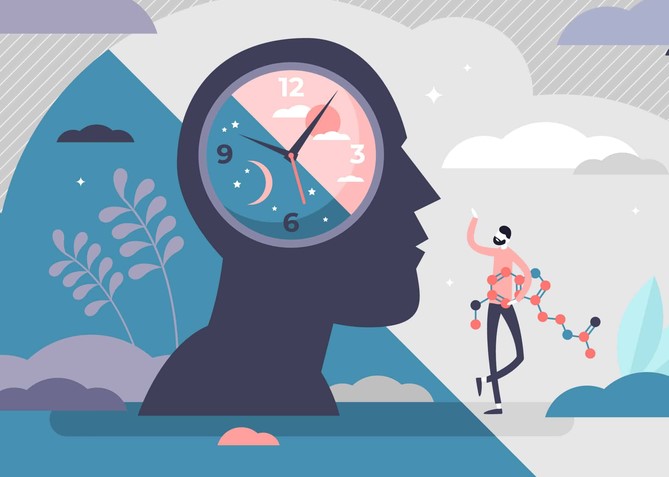
It is 3:00 AM. You are staring blankly at the ceiling, your mind racing, while a heavy sense of dread settles in because your alarm is set to go off in exactly four hours. Yet, when 7:00 AM finally rolls around, you feel like a zombie, dragging your feet toward the coffee maker just to function.
If this cycle feels frustratingly familiar, you are not suffering from a lack of willpower. You are simply out of sync with your internal clock.
Over my ten years as a health writer working alongside sleep neurologists and metabolic experts, I have noticed a fascinating trend. People spend thousands of dollars on luxury mattresses, sleep trackers, and designer supplements, yet they still wake up exhausted.
The missing piece of the puzzle isn’t a product you can buy; it is master status biology, specifically circadian rhythm optimization. When you learn how to align your biological clock with the natural world, effortless energy and deep sleep follow naturally.
The Master Clock: Meet Your Brain’s Internal Conductor
To understand why your energy crashes at 2:00 PM or why you feel wide awake at midnight, we need to peer inside your brain. Tucked away within the hypothalamus sits a tiny cluster of about 20,000 neurons called the suprachiasmatic nucleus (SCN).
The Master Conductor Analogy
Think of your body as a massive, world-class symphony orchestra. Your liver, heart, muscles, and hormones are all individual musicians waiting to play their parts.
The SCN is the master conductor of the orchestra.
Without a conductor keeping the tempo, the violinists play too fast, the drummers lose the beat, and the music turns into chaotic noise. Circadian rhythm optimization is the process of giving your master conductor the exact cues it needs to keep every organ system playing in perfect harmony.
The Hormonal Tug-of-War: Cortisol vs. Melatonin
Your internal clock governs almost every biological process, but its most visible job is regulating your sleep-wake cycle through two primary hormones: cortisol and melatonin.
In a healthy, optimized system, these hormones operate on a flawless daily seesaw:
-
The Morning Spike (Cortisol): As dawn breaks, light enters your eyes and signals the SCN to trigger a sharp rise in cortisol. This is known as the cortisol awakening response (CAR), which acts as your body’s natural espresso shot, boosting your body temperature and alertness.
-
The Nighttime Surge (Melatonin): As darkness falls, the pineal gland receives the signal to start manufacturing melatonin. This hormone gently lowers your core body temperature and prepares your brain for deep, restorative slow-wave sleep.
When your lifestyle forces these hormones to clash—like blasting your eyes with phone screens at midnight—the seesaw breaks. You end up wired but tired.
Actionable Steps for True Circadian Rhythm Optimization
Achieving perfect alignment doesn’t require upending your entire life. It requires mastering the environmental cues, known to scientists as zeitgebers (time-givers), that anchor your internal clock.
1. Own Your Morning Light Exposure
Light is the most powerful master control switch for your SCN. Viewing natural sunlight within the first 30 to 60 minutes of waking up anchors your circadian clock to the earth’s solar cycle.
-
Action Step: Step outside for 10–15 minutes every morning without sunglasses. Even on a cloudy day, photons from the sky penetrate the cloud cover and deliver exponentially more light energy than bright indoor office bulbs.
2. Guard Your Evenings Against Blue Light
Just as morning light turns your system on, artificial light at night tricks your brain into thinking it is still noon. Blue and green wavelengths emitted by smartphones, TVs, and LED bulbs rapidly suppress melatonin production.
-
Action Step: Dim your house lights by 50% after 8:00 PM. Switch your devices to “Night Shift” mode, or better yet, put them away entirely 60 minutes before your head hits the pillow.
3. Anchor Your Meal Timing (Chrononutrition)
Your brain isn’t the only clock in your body; your digestive organs have peripheral clocks that listen closely to when you eat. Eating a heavy meal late at night forces your metabolism to work overtime when it should be cooling down for cellular repair.
-
Action Step: Try to establish a consistent eating window. Avoid consuming caloric foods or sugary drinks at least 3 hours before your bedtime to allow your core body temperature to drop efficiently.
The Master Timeline for Peak Vitality
| Time of Day | Ideal Action | Circadian Benefit |
| 07:00 AM | View direct sunlight & move body | Triggers the Cortisol Awakening Response |
| 10:00 AM | Deep focus work & first coffee | Peak cognitive function and alertness |
| 02:00 PM | Light movement or brief walk | Combats the natural post-prandial afternoon dip |
| 08:00 PM | Dim indoor lights & wind down | Allows natural melatonin synthesis to begin |
Expert Advice for Long-Term Success
💡 Pro Tip: The Weekend “Social Jetlag” Trap
Throughout my decade in the health niche, the most common mistake I see intermediate biohackers make is maintaining a perfect routine Monday through Friday, only to sleep in for three extra hours on Saturday and Sunday. This creates a phenomenon known as social jetlag. Shifting your sleep schedule by more than an hour on the weekend completely confuses your SCN, making Monday morning feel like you just flew across four time zones. Keep your wake time consistent within a 60-minute window, 7 days a week.
Tuning Your Cellular Symphony
Optimizing your circadian biology is ultimately about respect—respecting the ancient evolutionary blueprint coded into your DNA. By aligning your daily habits with the natural cycles of light and dark, you stop fighting against your own biochemistry. You will find that sleep becomes effortless, morning grogginess fades away, and your daytime focus reaches heights you didn’t think were possible.
Are you a natural night owl struggling to adjust to an early schedule, or an early bird who crashes too soon? What is the one adjustment you will make to your light exposure routine today? Share your thoughts and experiences in the comments below, and let’s discuss!