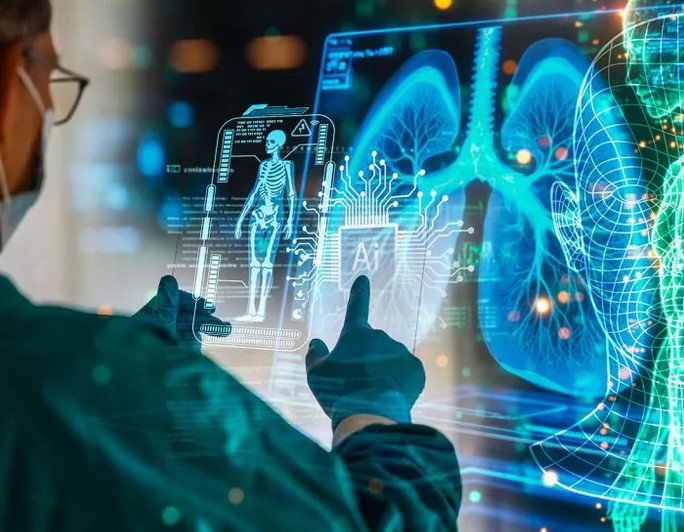
Imagine a world-class radiologist who never sleeps, never gets distracted by a morning headache, and has memorized every medical image ever taken in human history. Now, imagine that this expert can “see” a tumor the size of a grain of sand buried deep within a complex lung scan in less than a second. This isn’t science fiction; it’s the reality of modern triage in some of our most advanced hospitals today.
In my decade of covering health tech, I’ve sat in labs where “early detection” used to mean months of waiting and uncertainty. I remember speaking with a technician in 2016 who spent hours manually circling suspicious shadows on X-rays. Fast forward to 2026, and I’ve watched that same process happen near-instantaneously through AI-Powered Diagnostics.
The shift isn’t just about speed; it’s about shifting our entire healthcare philosophy from “reactive” (fixing what is broken) to “predictive” (preventing the break). Let’s peel back the curtain on how artificial intelligence is becoming the most important tool in a doctor’s kit.
1. The “Extra Set of Eyes” Analogy: How AI Actually Works
To understand AI-Powered Diagnostics, we have to move past the “Terminator” Hollywood tropes. In the clinic, AI doesn’t act like a robot doctor; it acts like a high-powered magnifying glass with a memory.
Think of a “Where’s Waldo?” book. A human might take a few minutes to find Waldo because our eyes get tired and the red-and-white stripes start to blur. An AI system, however, has been trained on billions of pictures of Waldo. It doesn’t “look” at the page; it mathematically identifies the specific pattern of Waldo’s shirt instantly.
In medical terms, this is called Computer-Aided Detection (CAD). Whether it’s a skin lesion, a retinal scan, or a complex MRI, the AI is looking for patterns that are too subtle for the human eye to consistently catch.
2. The Pillars of AI-Powered Diagnostics in 2026
We are seeing AI impact three major “theaters” of healthcare. Understanding these will help you navigate the next time you visit a specialist.
A. Medical Imaging and Radiology
This is the “gold standard” for AI-Powered Diagnostics. By using Deep Learning algorithms, software can now analyze CT scans for signs of stroke or hemorrhage with higher accuracy than an exhausted resident on a 24-hour shift.
-
The Goal: Reducing the “Time to Treatment.”
-
LSI Term: This often utilizes Convolutional Neural Networks (CNNs), a specific type of AI designed to process visual data.
B. Pathology and Lab Results
Traditionally, a pathologist looks at tissue samples under a microscope. It’s slow and subjective. Today, digital pathology platforms use AI to count cancerous cells and grade their aggressiveness. This leads to Precision Medicine, where your treatment is tailored to the exact “fingerprint” of your disease.
C. Predictive Analytics and Wearables
The fitness tracker on your wrist is now a diagnostic tool. By monitoring Heart Rate Variability (HRV) and sleep patterns, AI can predict if you are getting sick days before you feel a single symptom. This is the “smoke detector” of the human body.
3. Beyond the Hype: The Human-AI Partnership
I often hear the concern: “Will AI replace my doctor?” In my 10 years in this field, I’ve seen the exact opposite. AI is a liberator.
When AI handles the mundane task of sorting through thousands of normal “healthy” scans, it frees up the doctor to focus on the complex, edge-case patients who need human intuition. We call this Augmented Intelligence. The AI provides the data; the doctor provides the empathy, the context, and the final decision.
💡 Pro Tip: The “Second Opinion” Strategy
If you are ever faced with a complex diagnosis based on imaging (like a biopsy or an MRI), don’t be afraid to ask: “Was this scan processed through an AI triage system?” Many modern clinics use AI to flag “high-priority” results. Knowing that your case was dual-verified by both a human and an algorithm can provide an extra layer of peace of mind.
4. Addressing the “Black Box” Problem and Algorithmic Bias
We have to be honest about the hurdles. One of the biggest challenges in AI-Powered Diagnostics is what we call the “Black Box” Problem. Sometimes, an AI can tell that a patient is sick, but it can’t explain why it reached that conclusion.
Furthermore, if an AI is trained only on data from one specific demographic, it might struggle to accurately diagnose people of different ethnicities or ages. This is why Data Diversity is the hottest topic in health tech right now. We are working hard to ensure that the “Future of Healthcare” is a future that works for everyone, regardless of their background.
5. The Technical Edge: Natural Language Processing (NLP)
It’s not just about images. A huge part of AI-Powered Diagnostics involves Natural Language Processing (NLP). This technology “reads” through millions of disorganized medical records, doctor’s notes, and lab reports to find hidden connections.
For example, an NLP system might notice that five different patients who all saw different doctors are exhibiting a rare combination of symptoms after taking the same medication. This helps us catch Adverse Drug Reactions and rare diseases months—or even years—sooner than we previously could.
6. The Future: From Clinics to Your Kitchen Table
Within the next few years, I predict we will see AI-Powered Diagnostics move from the hospital into the home. We are already seeing “Smart Toilets” that analyze waste for signs of kidney issues and smartphone apps that can detect anemia just by looking at a photo of your fingernails.
This democratization of data means that you won’t have to wait for an annual checkup to know if something is wrong. You will have a “Digital Health Guardian” watching over you 24/7.
The Rise of “Cyberchondria”
Here is a “Hidden Warning” from someone who has seen the data: More data does not always mean more health.
The Danger: As diagnostic tools become available on our phones, there is a risk of “Cyberchondria”—the anxiety caused by misinterpreting AI-generated “risk scores.” An AI might tell you that you have a “3% increased risk” for a condition, which sounds scary but is statistically insignificant.
Expert Advice: Never use a consumer-grade AI app to self-diagnose. Use it as a conversation starter with a qualified medical professional. The tool is meant to facilitate a doctor’s visit, not replace it.
Summary: A New Era of Hope
AI-Powered Diagnostics is the bridge between our current “wait and see” healthcare system and a future where diseases are caught before they ever cause pain. By combining the cold, hard calculating power of machine learning with the warm, experienced intuition of human doctors, we are entering a golden age of longevity.
We are moving toward a world where a “late-stage” diagnosis becomes a relic of the past. It is an inspiriting time to be involved in health, and an even better time to be a patient.
Are you ready to trust the algorithm?
Technology is moving faster than our comfort levels sometimes allow. Some find the idea of a machine analyzing their body terrifying, while others find it liberating.
I want to hear from you: If a highly accurate AI told you that you were likely to develop a condition in five years, would you want to know? Or do you prefer the traditional “wait for symptoms” approach? Drop a comment below and let’s discuss the ethics of this digital frontier!